A holiday open house works because guests come and go across a set window instead of arriving all at once. That also means the food sits out longer than at a sit-down dinner. The plan that works: send invitations with a clear start and end time, serve a grazing menu on small platters you swap out, set up a self-serve drinks station, and follow the two-hour rule for anything perishable.
To make that concrete, this walkthrough follows one hypothetical host through the whole thing, from invitations to the last dish in the rack. The numbers are hers, chosen for her party. Yours will differ, but the method carries over.
Key takeaways
- An open house spreads guests across the window, so plan food for a steady stream rather than one peak.
- Serve from small platters and replace them rather than topping up, as FDA and USDA advise.
- Perishables shouldn’t sit at room temperature more than 2 hours, or 1 hour above 90°F.
- Keep hot food at 140°F or warmer and cold food at 40°F or colder.
- Refrigerate leftovers within 2 hours in shallow containers and use them within 3 to 4 days.
In this guide
- The scenario
- Three weeks out: invitations and headcount
- One week out: the grazing menu and quantities
- The drinks station
- On the day: flow and the two-hour rule
- After the last guest: cleanup and leftovers
- FAQ
- Put it on the calendar
The scenario
Say you’re Maya, and you’ve decided to host a holiday open house on a Saturday in December from 2pm to 5pm. You’re inviting neighbours, colleagues and a few families with children, about 40 people in total. You have a medium-sized kitchen, a dining table that can be pushed against a wall, and one refrigerator.
Maya’s goals are simple: nobody waits for food, nobody gets sick, and she actually gets to talk to her guests. Everything below serves one of those three.
Three weeks out: invitations and headcount
Three weeks ahead, Maya sends invitations with an RSVP date a week before the party. Open houses have a reputation for vague headcounts, so she asks guests to reply with how many are coming and roughly when.
- Clear times. “Drop in any time from 2 to 5” tells guests they don’t need to arrive at the start or stay to the end.
- Parking and children. A line on where to park and whether kids are welcome saves a dozen messages.
- Dietary needs. She asks guests to mention allergies or dietary needs so she can label dishes.
When replies come in, 38 people say yes. Most families plan to come early, colleagues in the middle, neighbours late. That spread is the whole advantage of an open house: Maya is feeding roughly a third of her guests at any one time, not all 38 at once.
One week out: the grazing menu and quantities
A grazing menu means lots of small, easy bites rather than a meal. Maya builds hers around foods that are safe and easy to hold, so she isn’t fighting the clock all afternoon.
Choosing what to serve
The University of Minnesota Extension’s guide to planning food for a crowd notes that dry foods and those high in sugar are almost always safe, along with breads, rolls, cakes without cream filling and fresh whole fruit. High-protein foods such as meat, milk and egg dishes are potentially hazardous, and low-acid foods like potatoes, rice, custards and gravies should be served with extreme caution. So Maya leans on the easy side and keeps the riskier items few and well controlled.
| Station | What Maya serves | How she keeps it safe |
|---|---|---|
| Bread and crackers | Baguette slices, crackers, breadsticks | Shelf-stable; refilled freely |
| Cheese and charcuterie | Two cheeses, sliced cured meats | Small boards swapped every hour from the fridge |
| Dips | Hummus, a yoghurt dip | Small bowls nested in bowls of ice |
| Hot bites | Meatballs | Slow cooker set to keep warm, checked with a thermometer |
| Fruit and veg | Whole clementines, grapes, crudités | Crudités on ice; whole fruit on the table |
| Sweets | Cookies, brownies, a fruit cake | Shelf-stable; set out in batches |
Working out quantities
There’s no official formula for how much people eat at a drop-in party, so Maya uses a simple method rather than a rule of thumb. She plans the food in three one-hour batches, one per hour of the party, sized for the guests she expects in that hour. Each batch is a set of small platters prepared in advance and waiting in the fridge or a low oven.
She adds a little extra to the first batch, because early arrivals tend to be families with hungry kids, and keeps a reserve of shelf-stable crackers and cookies for the unexpected. If a batch runs out early, the reserve fills the gap. If food is left over, it stayed cold in the fridge and wasn’t sitting out.

The drinks station
A self-serve drinks station keeps the host out of the kitchen and keeps the line away from the food table. Maya sets hers up on a side table in the living room, the opposite end from the food.
- Something warm: a slow cooker of mulled cider on low, with a ladle and mugs.
- Something cold: sparkling water and a pitcher of cranberry spritz, with a tub of ice and a scoop.
- Something for the adults: a couple of wines and a bucket of beer, with alcohol-free options just as visible.
- Supplies: cups, napkins, a bottle opener and a bin right next to the station.
She labels everything, including which drinks are alcohol-free, so children and drivers can help themselves. For ideas, see our alcohol-free drinks and more hosting guides in the lifestyle section.
A good open house isn’t one big spread. It’s a small spread, refreshed on time, three times over.
On the day: flow and the two-hour rule
Setting up for flow
Maya pushes the dining table against a wall so guests can move along one side, and starts the line with plates and napkins. The drinks station is in another room, and coats go to a bed upstairs. That keeps three natural stopping points apart so no single spot jams.
The two-hour rule, in practice
The FDA’s buffet guidance is clear: discard perishables left at room temperature for more than 2 hours unless they are kept hot or cold, and cut that to 1 hour when the temperature is above 90°F. Hot food should stay at 140°F or warmer, cold food at 40°F or colder. The FDA suggests preparing a number of small platters ahead and replacing serving dishes with fresh ones throughout the party.
USDA’s party food safety advice adds one step Maya writes on a sticky note: replace empty platters instead of adding fresh food to an existing dish. So her routine looks like this.
- 1:50pm. Batch one goes out. She notes the time on a card by the table.
- 2:50pm. Perishable platters come off, go in the bin or back to the kitchen, and batch two goes out on clean dishes.
- 3:50pm. Swap again for batch three.
- Throughout. Dips sit in bowls nested in ice, and she checks the meatballs with a thermometer each swap.
By swapping hourly, nothing perishable comes close to the 2-hour limit. The shelf-stable bread, cookies and whole fruit can stay out and simply get topped up.

After the last guest: cleanup and leftovers
At 5pm, the last neighbours wander home. Maya’s first job isn’t the dishes, it’s the food. USDA’s leftovers guidance says leftovers must be refrigerated within 2 hours of cooking or of being removed from an appliance keeping them warm, or within 1 hour above 90°F. Large amounts go into shallow containers to cool quickly.
- Bin it: anything perishable that has been out beyond the time limit.
- Fridge it: untouched reserve platters, in shallow containers, labelled with the date.
- Use it: within 3 to 4 days, or freeze for 3 to 4 months, reheating to 165°F.
- Then the rest: run the dishwasher, stack glasses, and leave the vacuuming for tomorrow.
A pre-lined bin in each room and a cleared kitchen counter before guests arrive make this half-hour job instead of a two-hour one.
FAQ
How long should a holiday open house last?
Three hours is a manageable window for most homes. It gives guests flexibility and lets you plan food in hourly batches.
How do I keep cold food cold on a buffet?
Keep it in the fridge until serving, use small platters, and nest dishes in bowls of ice. Cold food should stay at 40°F or colder.
Can the cookies and bread stay out all afternoon?
Dry, sugary foods and breads without cream fillings are generally considered safe to leave out, so they’re ideal for a long buffet. Perishables need the 2-hour limit.
What if more guests show up than expected?
Keep a reserve of shelf-stable snacks and one extra platter in the fridge. It’s cheaper than overbuying fresh food that may go to waste.
Put it on the calendar
Pick your date and your three-hour window, then send invitations with an RSVP date at least a week out. Once you have numbers, sketch your hourly batches on paper. If you’d rather not cook everything, order a platter or two from a local spot through our restaurant directory, and see our holiday entertaining ideas for more.
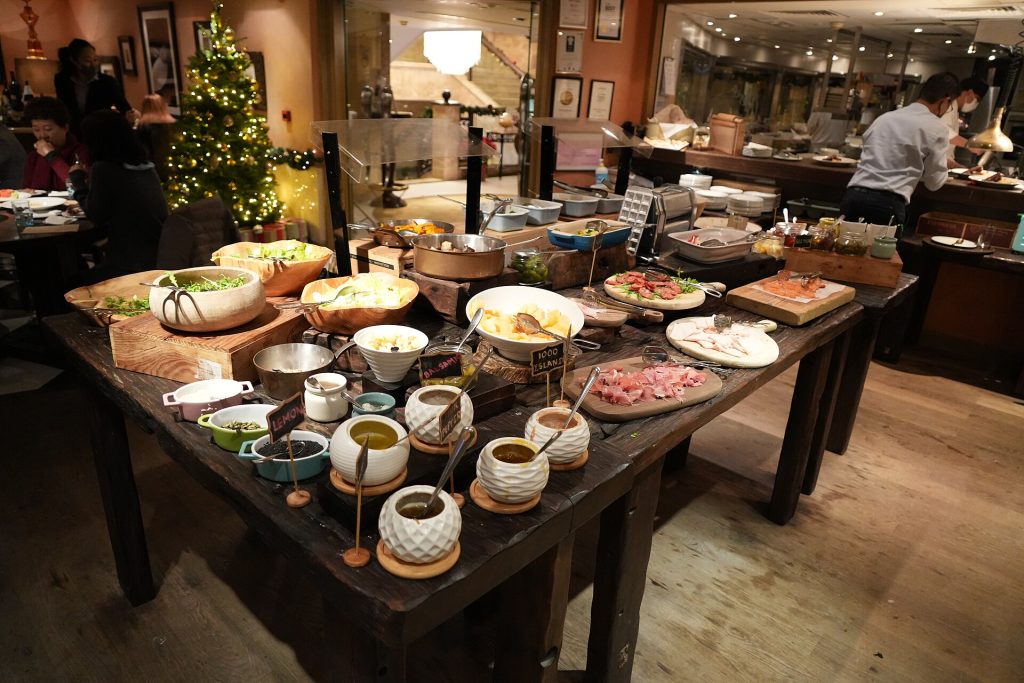
Featured photo: A some foods at buffet table in Holiday Inn Golden Mile Hong Kong by Peachyeung316, BY-SA 4.0.