Booking a private dining room for a holiday party comes down to a handful of numbers and a few lines of contract. Know your headcount, understand the food and beverage minimum, read the deposit and cancellation terms, and work out what service charges and tax add to the bill. Get those right in writing and the night mostly runs itself.
To make it concrete, we’ll follow one hypothetical booking from first enquiry to the last taxi. The group, the restaurant and every figure below are illustrative, not quotes from a real venue, but the structure mirrors the paperwork you’ll actually see.
Key takeaways
- A food and beverage minimum is a spending floor, not a room fee. If you spend less, you usually pay the difference anyway.
- Service charges and tax are normally calculated on top of the minimum, so budget from the all-in total.
- Lock the set menu and the final headcount on the dates the contract names, and ask what happens if numbers drop.
- Collect allergies and dietary needs with the RSVP, using the exact allergen names the kitchen will recognise.
- Book the AV check, the end time and the rides home before the night, not on it.
In this guide
- Meet the party: 24 guests, one Thursday in December
- The food and beverage minimum, decoded
- Deposits, set menus and the final headcount
- Service charges, tax and the real total
- AV, timing and the shape of the evening
- Contract clauses worth reading twice
- Managing the guest list
- FAQ
- Your next step: send three enquiries this week
Meet the party: 24 guests, one Thursday in December
Say you’re organising the end-of-year dinner for a 24-person team. The date is Thursday 10 December 2026, the budget from finance is a round figure per head, and you want a room with a door that closes, so speeches and a slideshow don’t compete with the main dining room.
You shortlist three restaurants with private rooms that seat between 20 and 30. You email all three on the same day with the same brief: date, a backup date, approximate headcount, budget per person including drinks, and whether you need a screen. Identical briefs make replies easy to compare.
- Restaurant A replies with a room that seats 28, a set menu in three price bands and a food and beverage minimum.
- Restaurant B offers a semi-private area behind a curtain, no minimum, but a compulsory set menu.
- Restaurant C has the nicest room and the highest minimum, and only has a 6pm slot left on your date.
Browse the restaurant directory or our events guides if you’re still building a shortlist.
The food and beverage minimum, decoded
Restaurant A’s email says the room carries a food and beverage minimum. This is the single most misunderstood term in private dining. It is the amount you agree to spend on food and drink in that room; it is not a separate charge for the space. If your party spends more, you simply pay the bill. If it spends less, the difference is usually charged as a shortfall or room fee.
Take an illustrative minimum of $2,400 for a weeknight. With 24 guests on a set menu of $70 a head, food alone comes to $1,680. Add a drinks package or bar tab, and you pass the minimum comfortably. Drop to 18 guests with light drinking, though, and you could land below it and pay for food nobody ate.
| Line item | Illustrative figure | What to ask |
|---|---|---|
| Food and beverage minimum | $2,400 (weeknight) | Is it higher on Fridays and Saturdays? Does it include tax and service? |
| Set menu | $70 per guest | What’s included: bread, sides, coffee, dessert? |
| Drinks | Package or consumption bar tab | Do drinks count toward the minimum? Can you cap the tab? |
| Service charge | Set by the venue, often a percentage | Is it on the pre-tax subtotal? Who receives it? |
| Sales tax | Your local rate | Is tax charged on the service charge too? |
| Deposit | A share of the minimum | Is it credited to the final bill? When does it become non-refundable? |
Ask directly whether the minimum is calculated before or after tax and service. The answer can move your real spend by a meaningful amount, and it is rarely spelled out in the first email.
A food and beverage minimum is a promise to spend, not a price for the room. Budget for the promise.
Deposits, set menus and the final headcount
Once you choose Restaurant A, the coordinator sends a contract and asks for a deposit to hold the date. In our scenario it’s a portion of the minimum, payable by card, credited against the final bill. The important dates are the ones that follow.
- Deposit due: on signing, to release the room from other enquiries.
- Menu selection: usually two to three weeks before the event. You pick one menu for the whole group, or a limited choice of starters and mains.
- Pre-orders, if required: some rooms ask each guest to choose a main in advance so the kitchen can plan portions.
- Final guaranteed headcount: often a few days before. This is the number you’ll be charged for, even if fewer people arrive.
A set menu is how a kitchen serves 24 plates at once while the main dining room carries on. Expect less flexibility than à la carte, and choose dishes that travel well from pass to table. Family-style platters can suit a relaxed team; plated courses suit a room with speeches.
Dietary needs and allergies
Collect dietary needs with the RSVP, not on the night. Ask guests to name allergens specifically. The FDA lists nine major food allergens: milk, eggs, fish, crustacean shellfish, tree nuts, peanuts, wheat, soybeans and sesame. Pass the list to the coordinator with guest names so each plate can be marked, and confirm the kitchen has it a few days out.
Service charges, tax and the real total
Here is where holiday party budgets usually slip. The menu price is not the price. On top of it you’ll usually see a service charge and sales tax, and depending on the venue, tax may apply to the service charge as well.
It helps to know what a service charge legally is. The IRS explains in its guidance on tips and service charges that a payment only counts as a tip when the customer voluntarily decides to pay it and chooses the amount. Automatic charges, such as a mandatory 18% charge for large parties, and required gratuities written into a contract or invoice are service charges, not tips. That matters because a service charge is the restaurant’s revenue to distribute under its own policy, so it is fair to ask how much reaches the staff working your room.
If you’re booking in California, the rules on disclosure are specific. The California Restaurant Association’s summary of SB 1524 explains that mandatory fees must be clearly and conspicuously displayed, with an explanation of their purpose, on menus and other displays showing prices, with compliance required by 1 July 2025. Wherever you book, ask for the fee in writing in the contract.
- Ask for an all-in estimate: menu, drinks, service charge and tax on one line.
- Decide on an extra tip separately. Anything you add voluntarily on top of a service charge is a tip.
- Check whether the minimum is met before or after service and tax.
AV, timing and the shape of the evening
Our team wants a short slideshow and two speeches. Private rooms vary widely here: some have a built-in screen and HDMI cable, others offer a TV on a stand, and some have nothing at all. Ask what’s there, whether a microphone is available, and whether there’s an extra fee.
A realistic run-of-show
| Time | What happens |
|---|---|
| 6:45pm | Organiser arrives, tests the screen and laptop, checks place cards |
| 7:00pm | Guests arrive, drinks and passed bites |
| 7:30pm | Seated; starters served |
| 8:15pm | Mains; short welcome speech between courses |
| 9:00pm | Dessert, slideshow, awards |
| 9:45pm | Coffee, bar closes, bill settled |
| 10:00pm | Room end time |
Hold speeches until plates are down. Servers can’t clear or pour while everyone is facing a screen, so agree with the coordinator where the pauses fall. And ask what happens if the party runs past the end time: some rooms charge an hourly overtime fee, others simply need the space back.
Contract clauses worth reading twice
A few clauses decide who pays when plans change. Read them before you sign.
- Cancellation schedule: how much of the deposit, or of the minimum, you forfeit at each date before the event.
- Attrition: whether lowering the headcount after the guarantee changes what you owe.
- Weather or emergency closure: whether the deposit transfers to a new date.
- Outside items: rules on cake, decorations, candles and corkage for your own wine.
- Damage and conduct: who is responsible for breakages, and any noise limits.
If the contract leaves something out, ask for it by email and keep the reply with the signed copy. For more on budgeting a group dinner, see our guide to group dining on a budget.
Managing the guest list
With 24 invitations out, two people haven’t replied and one wants to bring a partner. Keep a simple sheet with columns for name, RSVP, dietary needs, pre-ordered main and how they’re getting home.
- Set an RSVP deadline a few days before the restaurant’s headcount deadline, never on the same day.
- Decide plus-one rules in the invitation, so you’re not negotiating seat by seat.
- Plan the ride home. The NHTSA’s Drive Sober campaign notes that 1,038 people died in drunk-driving crashes in December 2023, and urges everyone to plan a sober ride before the night starts.
FAQ
What is a food and beverage minimum?
It’s the amount you commit to spend on food and drink in the room. If your bill falls short, the venue usually charges the difference.
Is the service charge the same as a tip?
No. Under IRS guidance, mandatory charges set by the business are service charges. A tip is voluntary and the amount is chosen by the customer.
When do I need the final headcount?
Whenever the contract says, often a few days before the event. That number is usually what you pay for.
Can we bring our own cake?
Often, but ask first. Some rooms charge a cake-cutting fee or ask for it to come from a licensed bakery.
Your next step: send three enquiries this week
Send the same short brief to three restaurants with private rooms, ask each for an all-in estimate and their contract, and compare the numbers side by side. Then set your RSVP deadline and start collecting dietary needs. For ideas on the night itself, read our holiday party ideas.
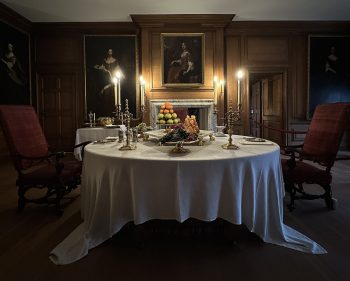
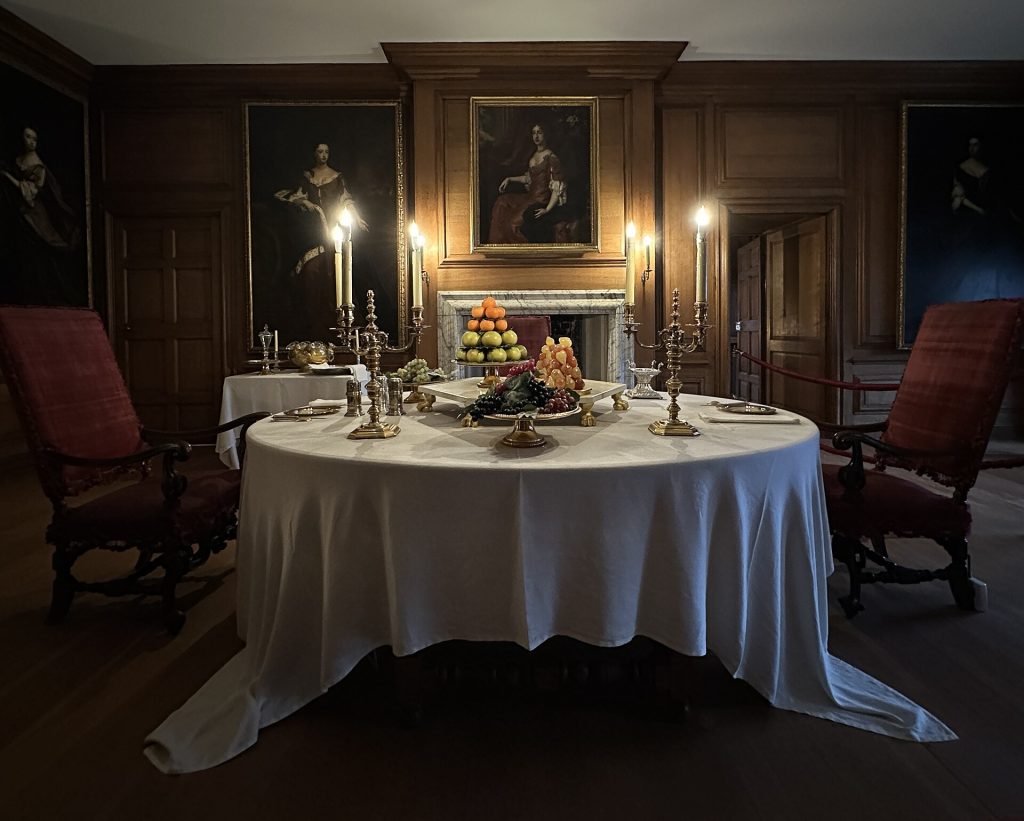
Featured photo: King’s Private Dining Room, Hampton Court Palace – 2 by APK, BY 4.0.