Choosing a corporate food service provider is a significant operational decision. The right partner can improve employee satisfaction, simplify cafeteria management, and create a more consistent workplace dining experience. The wrong partner can lead to service problems, rising costs, limited menu variety, and frustration for both employees and management.
Because food service contracts often involve staffing, purchasing, compliance, reporting, and day-to-day operations, companies should evaluate potential providers carefully rather than choosing based only on menu samples or pricing.
A clear request-for-proposal process can help employers compare providers on the factors that matter most.
Define Workplace Needs Before Requesting Proposals
Before contacting vendors, companies should identify what they actually need from a food service program.
Important considerations include:
- Number of employees onsite each day
- Workplace schedule and shift structure
- Desired meal periods
- Existing kitchen and cafeteria facilities
- Expected participation levels
- Dietary preferences and restrictions
- Employer subsidy levels
- Grab-and-go or mobile ordering needs
- Catering requirements
- Budget expectations
A provider cannot design an effective program without understanding the workplace environment.
Companies should also consider how employee attendance may change throughout the week. Hybrid schedules, seasonal staffing, and multiple work shifts can all influence food demand.
Ask How Staffing Will Be Managed
Staffing is one of the most important parts of a food service contract.
Companies should ask how the provider recruits, trains, schedules, and manages employees assigned to the location.
Questions may include:
- How many staff members will normally be onsite?
- Who will manage daily operations?
- How are employee absences covered?
- What training is required?
- How does the provider handle turnover?
- Who is responsible for scheduling?
A strong menu is not useful if the provider cannot consistently staff the operation.
Employers should also understand whether the proposed staffing model is included in the quoted price or whether additional labor costs could arise later.
Evaluate Menu Flexibility
Employees generally expect more than the same limited selection every day.
A good provider should be able to offer enough variety while still controlling food waste and operating costs.
Companies should ask how often menus change, how seasonal items are incorporated, and how the provider responds to employee feedback.
Dietary requirements are also increasingly important.
Providers should be prepared to address common needs such as:
- Vegetarian options
- Vegan meals
- Gluten-sensitive choices
- Food allergies
- Lower-calorie selections
- High-protein options
The goal is not to satisfy every individual preference, but the dining program should serve a broad portion of the workforce.
Use the RFP to Compare Providers Consistently
Without a structured process, companies may receive proposals that are difficult to compare.
One provider may emphasize menu quality while another focuses on pricing, technology, or staffing. A standardized list of corporate food service RFP questions can help employers evaluate vendors across the same operational categories.
The RFP should ask for clear information about:
- Staffing structure
- Menu planning
- Food sourcing
- Pricing
- Management fees
- Equipment responsibilities
- Reporting
- Technology
- Food safety
- Performance standards
Using consistent questions makes it easier to identify meaningful differences between proposals.
Understand the Full Pricing Structure
Food service pricing can be more complicated than it first appears.
Companies should understand whether the provider operates under a management-fee structure, profit-and-loss arrangement, subsidy model, or another contract format.
Ask providers to explain all expected costs, including:
- Management fees
- Labor
- Food costs
- Administrative expenses
- Technology fees
- Equipment costs
- Maintenance responsibilities
- Credit-card processing
- Catering charges
- Startup expenses
Employers should also understand how pricing may change over time.
For example, the contract should explain how food-cost increases, wage changes, or declining participation will affect the employer.
Transparent pricing makes it easier to evaluate the true cost of each proposal.
Ask About Food Safety and Compliance
Food safety should be treated as a core operational requirement.
Companies should ask how providers train employees, monitor food temperatures, prevent cross-contamination, manage allergens, and respond to health or safety concerns.
Providers should also explain how they handle:
- Health inspections
- Employee certifications
- Food recalls
- Cleaning procedures
- Pest control
- Equipment sanitation
- Incident reporting
A vendor should have documented procedures rather than relying on informal practices.
Review Technology Capabilities
Technology can influence both the employee experience and operational efficiency.
Depending on the workplace, useful features may include:
- Mobile ordering
- Cashless payment
- Self-checkout
- Digital menus
- Loyalty programs
- Employee meal credits
- Sales reporting
- Inventory tracking
Companies should determine which tools are actually useful for their workforce.
Technology should make service easier, not create unnecessary complexity.
Ask How Performance Will Be Measured
A good provider should be able to explain how it evaluates the success of the food service program.
Common performance measures include:
- Participation rates
- Daily transactions
- Average ticket value
- Food cost
- Labor cost
- Waste levels
- Employee satisfaction
- Service speed
Companies should also ask how often reports will be provided and who will review performance with the employer.
Regular reporting makes it easier to identify problems before they become significant.
Request References From Similar Clients
References are most useful when they come from organizations with similar operating environments.
A provider serving a large manufacturing facility may face very different challenges from one serving a small professional office.
Companies should ask references about:
- Service consistency
- Staff quality
- Communication
- Menu variety
- Problem resolution
- Billing accuracy
- Contract transparency
References can provide valuable insight into how a provider performs after the sales process is over.
Discuss Transition Planning
Changing food service providers can create temporary disruption if the transition is not managed carefully.
Employers should ask potential vendors how they handle:
- Employee onboarding
- Equipment transfer
- Inventory
- Vendor relationships
- Menu launches
- Communication with employees
- Opening-day staffing
A detailed transition plan reduces the risk of service interruptions.
Compare More Than Price
Price is important, but the lowest-cost proposal is not always the best value.
Corporate food service affects employees every day. Poor service, long lines, inconsistent staffing, and poor food quality can quickly reduce participation.
Companies should evaluate each provider based on the complete operating model.
A strong corporate food service partner should understand the workplace, communicate clearly, manage costs responsibly, maintain consistent staffing, and adapt as employee needs change.
By asking detailed questions before signing a contract, employers can make a more informed decision and build a food service program that performs well over the long term.
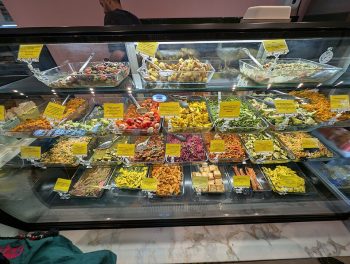
Featured photo: Salad bar at Cibus, London by Andy Li, CC0.