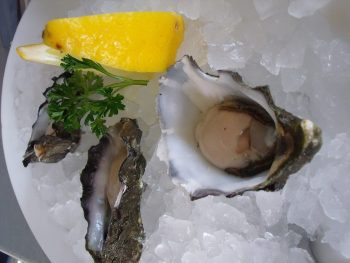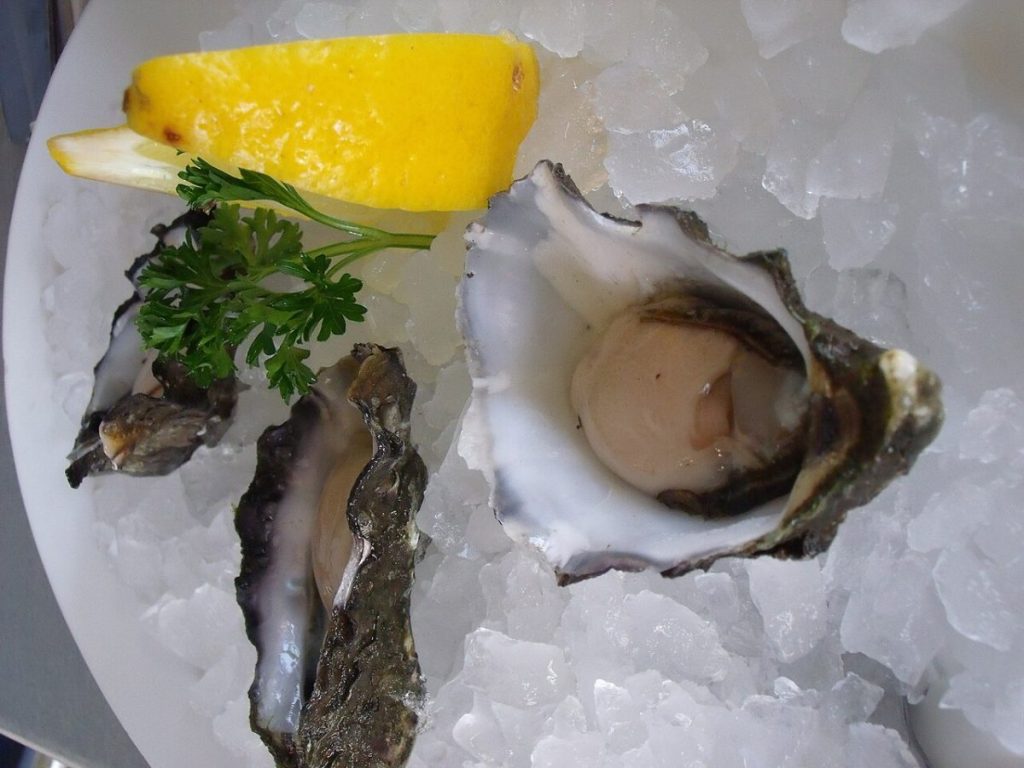
The short answer on how to eat oysters: pick the shell up by its wide end, make sure the oyster is loose from the shell, add a drop of lemon or mignonette, tip it into your mouth with its liquor, chew once or twice and swallow. That’s it. Raw oysters are served shucked on the half shell over crushed ice, and nobody expects you to know every variety on the board.
This guide covers how to order at a raw bar, what the sauces are for, the main oyster species you’ll see on menus and the safety facts that actually matter.
Key facts
- Raw oysters are usually ordered by the half dozen or dozen and served on the half shell over ice.
- Classic toppings are lemon, cocktail sauce, horseradish and mignonette (shallots in vinegar). Use a little; the oyster is the point.
- Most oysters sold in the US belong to a handful of species: Eastern, Pacific, Kumamoto and European flat.
- According to the CDC, lemon juice, hot sauce and alcohol do not kill Vibrio bacteria, and a contaminated oyster looks, smells and tastes normal.
- The FDA advises people at higher risk, including pregnant women, older adults and anyone with a weakened immune system, to avoid raw oysters.
How do you order oysters at a raw bar?
Most raw bars list their oysters by name, usually the place they were grown, with the price per piece. Names like Wellfleet, Blue Point or Kumamoto tell the shucker exactly which tray to reach for. A few simple habits make ordering easy:
- Start with a half dozen per person. You can always add more, and oysters taste best freshly shucked.
- Mix two or three varieties. Two of each lets you compare briny East Coast oysters with sweeter West Coast ones.
- Ask what tastes best today. Servers and shuckers know what came in fresh and which oysters are small, creamy or salty.
- Say how you like them. If you’re new, ask for smaller, milder oysters. Large ones can be a big mouthful.
- Check for a happy hour. Many oyster bars run discounted oysters at set times, often on a house variety.
What are the sauces and toppings for?
A platter usually arrives with lemon wedges, a red cocktail sauce, grated horseradish and a small dish of mignonette. Here is how each one works:
| Topping | What it is | Best with | How much |
|---|---|---|---|
| Lemon | A squeeze of fresh citrus | Almost any oyster | A few drops |
| Mignonette | Minced shallot in vinegar, often with cracked pepper | Briny East Coast oysters | Half a teaspoon |
| Cocktail sauce | Ketchup-style sauce with horseradish | Larger, milder oysters | A small dab |
| Horseradish | Freshly grated root, very sharp | Anyone who likes heat | A pinch |
| Hot sauce | Bottled chile sauce | Gulf-style service | One or two drops |
| Nothing | The oyster and its liquor | Your first taste of a new variety | None |
A good rule: eat the first oyster of each variety plain. That’s the only way to taste the difference between them.
How do you actually eat a raw oyster?
- Look and smell. A fresh oyster should look plump and moist, sit in a little clear liquid (the liquor) and smell like clean sea water. If it looks dry or smells off, don’t eat it; tell your server.
- Loosen it. The shucker should have cut the muscle that holds the oyster to the shell. Slide the small fork underneath to make sure it moves freely.
- Add a topping, or don’t. A few drops of lemon or a little mignonette is plenty.
- Tip it in. Lift the shell by the wide end, bring the edge to your lips and let the oyster and liquor slide in.
- Chew once or twice. Swallowing whole is allowed, but a couple of bites releases the flavor, which is sweet, salty, buttery or mineral depending on the oyster.
- Set the empty shell back on the ice. Some diners turn empty shells over so they can see what’s left; it’s a habit, not a rule.
Using the little fork to eat the oyster straight off the shell is also fine, especially at a sit-down dinner. Etiquette at a raw bar is relaxed; our guide to restaurant etiquette myths covers other rules you can stop worrying about.
Which kinds of oysters will you see on the menu?
Menus may list a dozen names, but most come from only a few species. The Discover West Coast Seafood guide from UC Santa Barbara describes the main ones grown on the Pacific coast, including species brought in from Japan and the East Coast.
- Eastern oyster (Crassostrea virginica), also called Atlantic or American oyster. Most East Coast and Gulf oysters are this species, and they are typically briny and clean.
- Pacific oyster (Crassostrea gigas), originally from Japan and well established in Washington since the 1920s. Often sweeter, with frilly shells.
- Kumamoto (Crassostrea sikamea), a small, deep-cupped Japanese species grown on the West Coast. A popular first oyster because of its size.
- European flat oyster (Ostrea edulis), sometimes sold as Belon. Flat, round and strongly mineral.
Within a species, flavor changes with the water an oyster grows in, which is why the same species from two bays can taste quite different.
Are raw oysters safe to eat?
Most people eat raw oysters without problems, but there is a real risk, and it’s worth knowing the facts rather than the folklore. The CDC’s page on Vibrio and oysters says an oyster carrying Vibrio bacteria doesn’t look, smell or taste different from any other oyster, and that hot sauce, lemon juice and alcohol do not kill the bacteria. Most infections happen in warmer months, but cases are reported all year, so the old rule about only eating oysters in months with an R is not a safety guarantee.
The FDA’s seafood safety guidance advises pregnant women, children, older adults and people with weakened immune systems to avoid raw oysters, even ones treated after harvest. For everyone else, eat at busy, reputable raw bars, skip any oyster that looks dry or smells wrong, and choose cooked oysters (roasted, fried or in a stew) if you’re unsure. Cooked oysters should be heated thoroughly; FDA guidance is 145°F for most seafood.
What should you drink with oysters?
Crisp, dry and lightly salty drinks work best. Classic choices are Muscadet, Chablis or another unoaked white, brut sparkling wine, a dry lager or a stout. If you want a cocktail, a gin martini is a traditional match. For a wider spread, see our guide to tasting menus versus ordering à la carte, since many seafood restaurants offer both.
Frequently asked questions
Should you chew or swallow oysters?
Chew once or twice. Swallowing whole is fine, but a couple of bites releases the flavor, which is the reason to order different varieties.
Do you drink the liquid in an oyster?
Yes. The clear liquid, called the liquor, is part of the experience. A fresh oyster should sit in some of it, and it should smell like clean sea water.
How many oysters should one person order?
A half dozen is a good starter portion, and a dozen is a light meal. Order in rounds so each batch is freshly shucked.
Does lemon or hot sauce make raw oysters safe?
No. The CDC says lemon juice, hot sauce and alcohol don’t kill Vibrio. Only thorough cooking does.
Can you only eat oysters in months with an R?
No. Infections are more common in warm months, but the CDC reports cases year-round, and oysters are served all year at reputable raw bars.
The short version
Order a half dozen, try the first one plain, loosen each oyster with the fork, tip it in from the wide end and chew a little. Ask the shucker for help choosing, and know the safety facts before you go. For more dining guides, browse our Eat Out section, or plan an oyster trip with our Charleston food guide.
Featured photo: Oysters served on ice, with lemon and parsley by David, public domain.