A tip is money you choose to leave, in an amount you decide, for the people who served you. A service charge is a fee the restaurant adds to your bill, and that one difference changes almost everything: who gets the money, how it is taxed, and whether you can refuse it. That is the short answer to the restaurant service charge vs tip question.
The confusion is understandable. Many places now print a percentage on the bill with a label like “service,” “hospitality fee” or “auto-gratuity,” and then still leave a blank tip line underneath. You are left guessing whether the server already got paid or whether you are about to underpay someone who worked hard for your table.
This explainer sorts out the definitions, what US federal rules and California law actually say, and a simple routine for handling the bill without awkwardness.
Key takeaways
- A tip is voluntary and the customer sets the amount. A mandatory service charge is not a tip, even when it is called a gratuity.
- The IRS generally treats service charges as regular wages, not tips, and federal wage law lets employers count them toward pay.
- The FTC’s junk-fee rule covers live-event tickets and short-term lodging, not restaurant bills.
- California requires all-in pricing, but restaurants may list a separate mandatory fee if it is clearly shown wherever prices appear.
- When a bill has both a service charge and a tip line, ask how the charge is distributed before deciding what to add.
What a service charge actually is
The IRS sets out four factors that make a payment a tip. The payment has to be made free from compulsion, the customer must have the unrestricted right to set the amount, it can’t be dictated by employer policy or negotiated, and the customer generally gets to decide who receives it. If a charge fails those tests, it isn’t a tip for tax purposes, whatever the menu calls it.
That is why the classic “18% added for parties of six or more” is a service charge. The IRS lists a large dining party automatic gratuity as a service charge, alongside banquet event fees and bottle service charges at nightclubs and restaurants. You didn’t choose it, and you didn’t pick the amount.
Common labels you will see
- Auto-gratuity or large-party gratuity: a fixed percentage added for bigger tables.
- Service charge or service fee: a percentage added to every check, often in place of tipping.
- Kitchen, wellness or hospitality fee: a surcharge the restaurant says funds back-of-house pay, benefits or other costs.
- Event or private dining fee: common on banquet menus and buyouts.
The label tells you what the restaurant intends the money for. It doesn’t legally turn a mandatory charge into a tip.
Where the money goes
When you leave a tip, federal law protects it. The US Department of Labor states that the Fair Labor Standards Act prohibits employers from keeping any portion of employees’ tips for any purpose, whether directly or through a tip pool. Managers and supervisors can’t take a cut of the pool either.
A service charge sits on the other side of the line. The same Labor Department guidance says a compulsory charge for service, such as 15 percent of the bill, is not considered a tip under the FLSA, and that these charges can be used to satisfy minimum wage and overtime obligations. In plain terms, the money is revenue to the business, which it may then pay out as wages.
A service charge is the restaurant’s money until it decides otherwise. A tip is the staff’s money from the moment you leave it.
Many restaurants do pass all or most of the service charge to front- and back-of-house staff, and some use it to replace tipping entirely with steadier hourly pay. Others use part of it for costs like benefits. None of that is visible from your receipt, which is why asking is reasonable.
How the tax treatment differs
The IRS says service charges are generally reported as non-tip wages paid to the employee, handled like standard wages for withholding. Tips are reported separately by the employee to the employer. It is a back-office detail, but it explains why a restaurant can’t simply relabel a mandatory fee as a tip on the paperwork.
Service charge vs tip, side by side
| Tip | Service charge | |
|---|---|---|
| Who decides the amount | You | The restaurant |
| Can you decline it | Yes | Generally no, if it was disclosed |
| Who owns the money | The employees who receive it | The business, which may distribute it as wages |
| Federal tip protections (FLSA) | Apply | Do not apply |
| IRS treatment | Reported tip income | Generally non-tip wages |
| Typical examples | Cash on the table, tip line on the card slip | Large-party auto-gratuity, banquet fee, bottle service charge |
Keep this grid in mind next time a check arrives with two percentages on it. The line you can edit is the tip. The line you can’t is the service charge.
The disclosure rules that apply
The FTC junk-fee rule
The Federal Trade Commission’s Rule on Unfair or Deceptive Fees took effect on May 12, 2025. According to the FTC’s own FAQ, it covers businesses selling live-event tickets and short-term lodging, including third-party platforms and resellers. Restaurant meals are not among the covered categories, so that rule doesn’t set how a restaurant must show a service charge.
California’s SB 478
California went further. Since July 1, 2024, the state’s hidden-fee law has required businesses to advertise the full price a consumer must pay; the California Attorney General’s guidance sums it up as the price a Californian sees should be the price they pay. Government taxes and reasonable shipping costs can be left out.
Restaurants, bars and food vendors got a carve-out. Under SB 1524, they may keep a mandatory fee separate from menu prices as long as the fee is clearly and conspicuously displayed wherever prices are shown. The Attorney General also notes that voluntary tips are not affected by the law and remain governed by other rules, including Labor Code section 350.
Everywhere else
Rules vary by state and city, and some local governments have their own requirements for how surcharges are labelled. The practical takeaway for diners is the same everywhere: a fee you were told about before ordering is part of the price, and a fee that appears only on the check is worth questioning.
How to handle a service charge at the table
You don’t need to interrogate the server. A short, friendly routine covers almost every situation.
- Scan the menu and booking page first. Look for a line near the bottom of the menu or in the reservation confirmation. If a fee is disclosed there, you can decide before you order.
- Read the check before you sign. Look for any percentage above the total, and note whether a tip line still appears below it.
- Ask one question if it’s unclear. “Does the service charge go to the staff?” is polite and gets a straight answer at most places.
- Adjust your tip to the answer. If the charge replaces tipping and goes to staff, adding more is optional. If it funds other costs, tip as you normally would on top.
- Raise surprises calmly. If a mandatory fee wasn’t disclosed anywhere, ask a manager about it. Being clear and courteous tends to resolve it quickly.
If you’re unsure what a normal tip looks like in the first place, our guide on how much to tip at restaurants is a good starting point, and you can browse more eating out guides for the rest of the night.
FAQ
Is an automatic gratuity the same as a tip?
No. Because it’s mandatory and the restaurant sets the amount, the IRS classifies a large-party automatic gratuity as a service charge, even though the word “gratuity” is in the name.
Can I refuse to pay a service charge?
If the charge was clearly disclosed before you ordered, it’s part of the price you agreed to. If it appeared without any notice, raise it with a manager and ask for it to be removed or explained.
Do I still need to tip if there’s a service charge?
It depends on where the money goes. If the restaurant says it goes entirely to staff and replaces tipping, extra is a bonus. If it covers other costs, a normal tip on top is fair to your server.
Does the FTC ban restaurant service fees?
No. The FTC’s fee rule that took effect in May 2025 applies to live-event tickets and short-term lodging, not restaurants. State and local rules, such as California’s, may still apply.
Before your next booking
Next time you book, take ten seconds to check the menu footer or confirmation email for a fee, then ask the one question that matters if the check surprises you. Planning a night out? Start with our restaurant directory and read up on restaurant etiquette so the only thing left to decide is what to order.
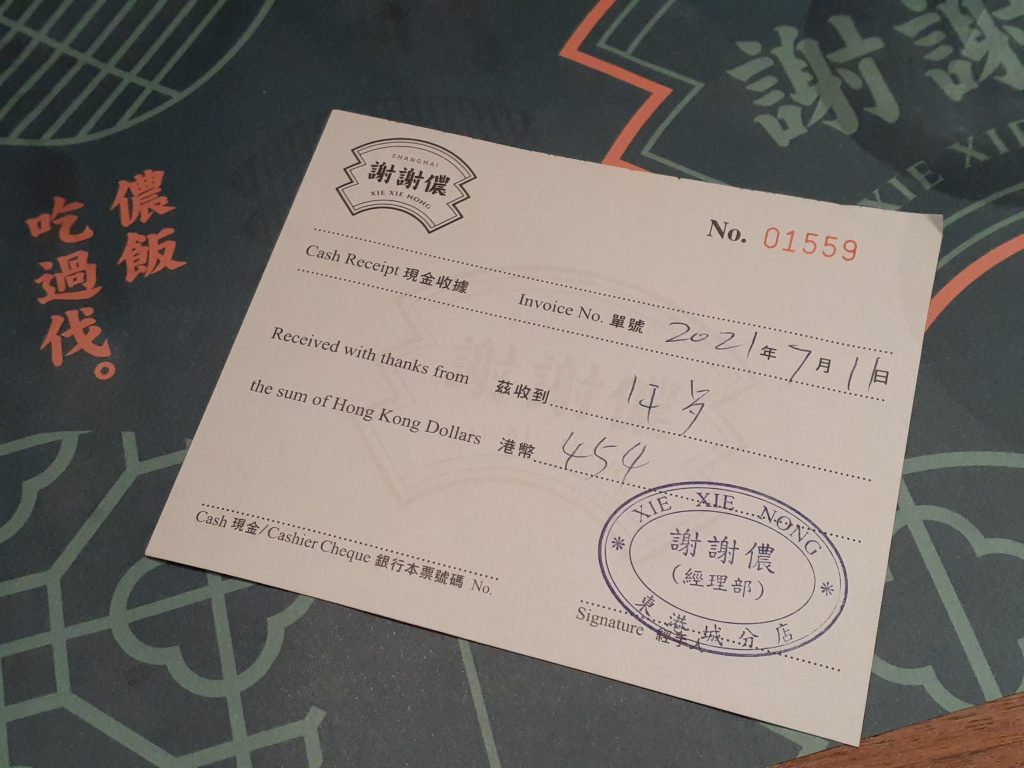
Featured photo: HK SKD TKO 將軍澳 Tseung Kwan O 坑口 Hang Hau 東港城 East Point City mall shop 上海 謝謝儂餐廳 Shanghai Xie Xie Nogn Restaurant bill receipt July 2021 SS2 by Hiqwm Wreop Uis, BY-SA 4.0.