Planning a birthday dinner at a restaurant for a big group comes down to five decisions made in the right order: the space, the menu, the money, the running order on the night and who pays for what. Get the space and the menu agreed in writing early, and almost everything else becomes a detail you can settle by email.
To make that concrete, this walkthrough follows one hypothetical party from first phone call to final toast. The numbers are illustrative, and every restaurant sets its own terms, but the sequence works for a 30th, a 70th or anything in between.
Key takeaways
- Book the space first. Weekend private rooms are limited, so lock in the room before anything else.
- A set menu with two or three choices per course keeps a 16-person kitchen order fast and predictable.
- Collect dietary needs early and pass them to the restaurant in writing, not on the night.
- Read the deposit, minimum spend, cake fee and large-party service charge terms before you sign anything.
- Decide how the bill will be split before the invitations go out, not when the card machine arrives.
In this guide
- The scenario: 16 guests, one Saturday
- Private room or reserved section
- Building the set menu
- Deposits, minimums and the cake fee
- Speeches, running order and splitting the bill
- FAQ
- Your eight-week timeline, starting this week
The scenario: 16 guests, one Saturday
Say your partner, Dana, turns 50 in May. You want a proper sit-down dinner on a Saturday night for 16 people: family, a few old friends and two colleagues. Budget matters, but the goal is a relaxed evening where Dana can talk to everyone, hear a couple of short speeches and not spend the night watching the clock.
You have eight weeks. Your shortlist is three restaurants Dana loves: a busy neighbourhood Italian, a steakhouse with a private dining room and a small wine bar that takes group bookings. Each will handle a party of 16 differently, and the differences shape everything that follows.
What you need to know before calling anyone
- A firm headcount range. “Fourteen to sixteen” is useful. “Maybe twenty” is not.
- Your date plus one backup. A Friday or a Sunday lunch is often easier to secure than a prime Saturday.
- A rough per-head budget covering food, drinks and service, so you can compare offers like for like.
- The must-haves. For Dana, that means one long table or a room quiet enough for speeches.
Private room or reserved section
The single biggest decision is where the group sits. A private room gives you a door, your own server and freedom to be loud. A reserved section of the main dining room usually costs less and feels livelier, but you share the atmosphere and the noise.
| Private room | Reserved section | |
|---|---|---|
| Speeches | Easy, with no other diners to disturb | Keep them short; room noise competes |
| Typical terms | Room hire or minimum spend, often a deposit | Deposit and a set menu are common |
| Atmosphere | Intimate, can feel quiet with few guests | Buzzy, borrowed from the main room |
| Decorations | Usually more flexibility | Often limited to the table |
| Timing | Room may be yours for a fixed window | Table may need turning for a later seating |
| Best for | Toasts, a slideshow, older guests | A celebratory night out that doesn’t need a mic |
In our scenario, the steakhouse’s private room seats up to 20 at one long table, while the Italian can reserve its back corner for a single seating. Because Dana wants two speeches and her mother struggles to hear in busy rooms, the private room wins, even though its minimum spend is higher.
Choose the space for the speeches you plan to give, not for the photos you hope to take.
Questions to ask on the first call
- How long is the room or section ours, and is there a later booking after us?
- Is there a minimum spend, a room fee, or both? What counts toward the minimum?
- Can we bring decorations, a cake or a small speaker?
- When is the final headcount due, and what happens if two people drop out?
Building the set menu
A kitchen can serve 16 plates at once far more smoothly when it knows what’s coming. Most restaurants will offer a set or group menu for parties this size, often with two or three options per course that guests choose in advance.
How the menu gets agreed
- Ask for the group menus and pick one tier that fits your per-head budget.
- Send guests the choices with the invitation and ask for their picks by a fixed date.
- Compile a single sheet: guest name, starter, main, dessert, dietary notes.
- Email the sheet to the events contact and ask them to confirm it back in writing.
Dietary needs belong on that sheet, not in a whisper to the server at 8pm. The US Food and Drug Administration recognises nine major food allergens: milk, eggs, fish, crustacean shellfish, tree nuts, peanuts, wheat, soybeans and sesame. Ask each guest directly, then let the restaurant tell you what it can safely do. In Dana’s group, one guest avoids shellfish and another is vegetarian, and both are handled on the menu sheet weeks before the night.
Drinks
Drinks can wreck a budget faster than food. The usual options are a drinks package, a bar tab with a cap, or guests paying for their own. Dana’s party goes with a welcome glass of sparkling wine and a set number of bottles on the table, then a cash bar after that. The limit is agreed with the manager beforehand, so staff know when to check in.
Deposits, minimums and the cake fee
This is where group bookings trip people up. Read the booking terms line by line, and if something isn’t written down, ask for it in an email.
- Deposit. Find out whether it’s refundable, by what date, and whether it comes off the final bill.
- Minimum spend. If your group spends less than the agreed minimum, you typically pay the difference. Ask whether service charges count toward it.
- Cake fee. Many restaurants charge a per-person fee to cut and plate a cake brought from outside. Ask the amount up front, or ask whether the kitchen can make the birthday dessert instead.
- Large-party service charge. An automatic percentage is common for big groups. Check the rate so you don’t tip twice by accident.
That last point matters more than it looks. The IRS lists a large dining party automatic gratuity as a service charge rather than a tip, because the customer doesn’t choose to pay it or set the amount. It isn’t a reason to avoid one, but it does mean you should ask how it’s distributed and whether a tip line on top is expected. Our explainer on service charges versus tips covers this in more detail.
Speeches, running order and splitting the bill
A simple running order
Speeches land best between the main course and dessert, when everyone is fed and no one is waiting for plates. Tell your server the plan so the kitchen can hold dessert for ten minutes. For Dana’s dinner, the night runs like this:
- 7:00 Guests arrive, welcome drink, no seating chart for the first 20 minutes.
- 7:30 Seated, starters served.
- 8:15 Mains served.
- 9:00 Two speeches, three minutes each, then a toast.
- 9:15 Cake out, candles, singing, dessert.
- 10:00 Coffee and settling up.
Splitting the costs
Decide the money model before the invitations go out, and say it clearly in the invitation. The three that work best:
- Host pays everything. The simplest night. You settle one bill.
- Fixed per-head contribution. Guests pay you a set amount for the set menu in advance. Drinks beyond the package are their own.
- Separate bills. Ask the restaurant beforehand whether it can split a group bill, and how. Many prefer one bill for large parties.
Dana’s family covers the dinner and the table wine, and guests pay for their own cash-bar drinks. Everyone knows that from the invitation, so no one is doing arithmetic on a phone at 10pm.
FAQ
How far ahead should I book a birthday dinner for 16?
For a weekend in a popular restaurant, start calling about two months out. Private rooms are limited, and many venues take group bookings well in advance.
Is a private room worth the extra cost?
It is if you plan speeches, have guests who find loud rooms hard, or want decorations. For a casual dinner with no toasts, a reserved section is often enough.
Can I bring my own birthday cake?
Usually, but ask first. Many restaurants charge a per-person fee for cutting and serving an outside cake, and some would rather make the dessert themselves.
Do I tip on top of a large-party service charge?
Ask the restaurant how the charge is distributed. If it goes to the staff and replaces tipping, extra is optional. If not, tip as you normally would.
Your eight-week timeline, starting this week
- 8 weeks out: Shortlist venues, call each, hold a date.
- 7 weeks out: Choose the space, pay the deposit, get the terms in writing.
- 6 weeks out: Send invitations with the menu choices and the payment model.
- 3 weeks out: Chase menu choices and dietary notes; order or confirm the cake.
- 1 week out: Send the final headcount and menu sheet; confirm timings and speeches.
- Day before: Reconfirm by phone; check who is bringing the cake and decorations.
- On the night: Arrive 30 minutes early; hand the running order to the lead server.
For more ideas on marking an occasion, browse our events guides and read up on booking private dining rooms.
Start at the top of that list today: pick your date and a backup, set a per-head budget, and call your top two venues with the questions above. If you’re still deciding where to go, our restaurant directory is a good place to find somewhere with room for the whole group.
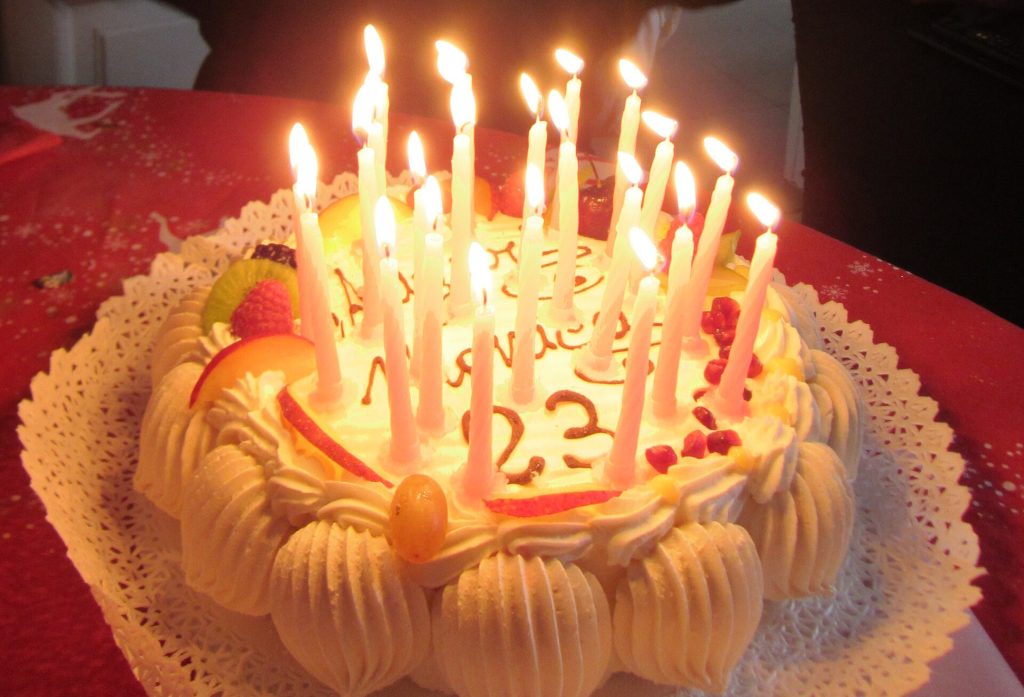
Featured photo: Italy – birthday cake with candles 5 by Francesca Cesa Bianchi, Milano, BY-SA 3.0 IT.