18+ Gaming content is for adults of legal age where they live. Gambling involves risk; please play responsibly.
The best card games for dinner parties are the ones you can explain in two minutes and play with a glass in one hand. For a big, lively group, go with Spoons or Crazy Eights. For a calmer table that wants to chat, Rummy works well. If you have exactly four people and a little patience for rules, Hearts or Euchre give you the most game for the evening.
A dinner party puts odd demands on a card game. The table is crowded with plates, some guests have never played, attention comes and goes, and nobody wants a rules lecture between courses. The right choice depends on headcount, how much space you have once the food is cleared, and how competitive your friends get.
This comparison covers five classic games, all playable with an ordinary deck, all played for fun rather than money.
Key takeaways
- Spoons suits the biggest groups and is the quickest to teach, but it’s loud and physical, so clear the glasses first.
- Crazy Eights plays with 2 to 8 people and is the ancestor of the family of games that includes Uno.
- Rummy is best for 2 to 4 players and leaves room for conversation.
- Hearts and Euchre are built for four; Euchre is played in partnerships with a 24-card deck in North America.
- Keep the stakes social: points, bragging rights or who does the dishes, never money.
The five games side by side
Player counts and deck details below come from the rules published on Pagat, the card game rules reference site. The learning curve, table space and food-friendliness ratings are our own judgement from a dinner-host’s point of view.
| Game | Players | Learning curve | Table space | Food-friendly? |
|---|---|---|---|---|
| Spoons | Flexible; one fewer spoon than players | Very easy | Needs room for spoons in the middle | Clear drinks first; it gets grabby |
| Crazy Eights | 2–8 | Easy | Small: a stock and a discard pile | Yes; relaxed pace |
| Rummy | 2–6, best with 2–4 | Easy to moderate | Medium: melds go face up on the table | Yes, with plates pushed back |
| Hearts | 4 (variants for 3 or 5+) | Moderate | Small: one trick at a time | Yes; seated and steady |
| Euchre | 4 in two partnerships | Moderate, with a few odd rules | Small: five-card hands | Yes; seated and steady |
Read the table from left to right the way you’d plan the evening. Count the guests first, then consider how much table you can realistically clear, then how much teaching you want to do.
Spoons: the icebreaker
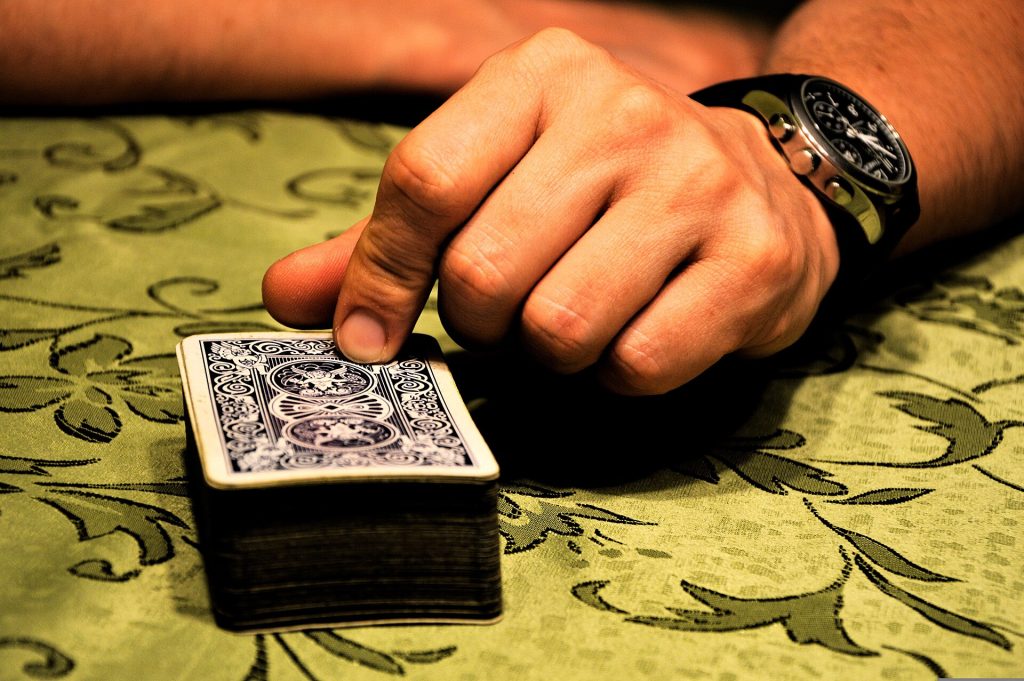
Spoons is a party game dressed as a card game. Pagat’s rules for Pig and Spoons describe a deck made up of four matching cards for each player and one fewer spoon than there are players, placed in the middle. Everyone passes cards around the circle at the same time, and when someone collects four of a kind they take a spoon. Then everyone grabs, and whoever is left without a spoon loses the deal.
- Why it works at a dinner party: anyone can learn it in a minute, and it gets people laughing straight away.
- What to watch: the grab. Move glasses, candles and anything hot away first, and use sturdy spoons, not the good silver.
- Best moment: between the main and dessert, when people need to stand up and stretch anyway.
Losers collect letters, traditionally spelling S-P-O-O-N-S, and drop out once they complete the word. A spoon is removed each time a player goes out, so rounds speed up as the table thins.
Crazy Eights: the easy crowd-pleaser
If your guests know Uno, they already know Crazy Eights. Pagat lists it for 2 to 8 players using a standard 52-card pack, or two packs shuffled together for bigger groups, with five cards each, or seven when only two play. You match the previous discard by number or suit, and eights are wild: play one on anything and name the next suit. Pagat notes that Uno is probably the best-known commercial game built on the same mechanism.
- Why it works: turns are quick, the rules fit in two sentences, and people can drift in and out between hands.
- House-rule fun: agree on a special card or two, such as a skip or a draw-two, and you have a homemade Uno.
- Table footprint: just a draw pile and a discard pile, so it fits next to the cheese board.
The best dinner-party game is the one nobody has to stop eating to learn.
Rummy: the slow-burn option
Basic Rummy works with 2 to 6 players but is best with 2 to 4, according to Pagat. With two players each gets 10 cards; with three or four, 7 cards; with five or six, 6 cards. You draw and discard, trying to form sets of three or four cards of the same rank, or runs of three or more in the same suit, and the first player to get rid of every card goes out.
Rummy’s pace is its strength. There is time to talk between turns, and nobody is eliminated, so quieter guests stay in the game. The trade-off is space, because melds go face up on the table where everyone can lay off cards onto them. Push plates back or play on a coffee table after the meal.
Scoring that stays friendly
When someone goes out, the others count what’s left in their hands: face cards 10, aces 1, number cards at face value. Play to an agreed total or a fixed number of deals. Setting a clear finish, such as “first to 100 or when dessert arrives,” keeps the game from swallowing the evening.
Hearts and Euchre: for a table of four
Hearts
Hearts is a four-player game with a standard deck, though Pagat notes versions for three and for five or more. The aim is to avoid points: each heart you take costs one and the queen of spades costs 13. Cards are passed before each hand, left, then right, then across, then held. The game ends when someone reaches 100, and the lowest score wins, unless someone shoots the moon by taking every penalty card.
It suits a table of four who enjoy a little strategy and a lot of groaning when the queen lands on them. Each trick takes up almost no room, so it plays well among coffee cups.
Euchre
Euchre is a trick-taking game for four players in fixed partnerships, with partners sitting opposite. North American Euchre uses a 24-card deck of aces down to nines, five cards per hand, and plays to 10 points. Its quirk is the bowers: the jack of trump is the highest card, and the other jack of the same colour counts as trump too. Pagat notes it is popular across a wide area of Canada and in the US North-East and Midwest.
Partnerships make Euchre a great mixer if you seat couples apart. The bower rule confuses newcomers for a hand or two, so play an open-handed practice round first.
Making cards and dinner work together
A few habits make the difference between a game that adds to the evening and one that takes it over.
- Pick the game before guests arrive, and have a spare deck ready in case of spills.
- Choose finger food for the game hour. Anything that leaves grease on hands leaves it on the cards.
- Clear a real surface. A side table or the cleared end of the dining table beats balancing cards between plates.
- Teach with an open hand. Play one round face up and talk through the choices.
- Keep stakes social. Play for points, bragging rights or choosing the next song, never money.
Looking for more ideas? Browse our gaming guides, see our tips for hosting a game night, and if you’d rather let someone else cook, the restaurant directory can find a place with a big table for the group.
FAQ
What’s the easiest card game for a large dinner party?
Spoons or Crazy Eights. Spoons scales with the group because you just add four matching cards and a spoon per extra player; Crazy Eights handles up to 8 with a second deck.
Which games need exactly four players?
Euchre is played by four in two partnerships. Standard Hearts is also a four-player game, though variants exist for three or for five or more.
Can I play these with children at the table?
Yes. Crazy Eights and Spoons are simple enough for mixed ages. Just keep Spoons away from hot dishes and breakables.
How do I keep things competitive without betting?
Keep score on paper and give the winner something social: first pick of dessert, choosing the music or being excused from washing up.
Pick one and deal it tonight
Count your likely guests, pick the game from the table above that matches, and put a deck by the dessert plates. If it goes well, pick a second game for next time, and try our dinner party menu ideas to plan the food around it.
Featured photo: UCB Playing Cards by ÅñtóñSûsî (Ð), BY 3.0 DE.