18+ Gaming content is for adults of legal age where they live. Gambling involves risk; please play responsibly.
The right card table for home game nights is the one that fits your room, seats your usual group without bumping elbows, and has a surface that survives snacks and drinks. For most households that means deciding three things first: folding or permanent, how many players, and which top suits the games you actually play.
This buyer’s guide works through those choices, then covers the details people forget until the first game night: where the drinks go, what everyone sits on, how the table is lit and where it lives the rest of the week. It is about furniture and hosting, not gambling. No brand picks, just the questions that separate a good table from a regret.
Key takeaways
- Decide folding versus permanent first; it settles size, weight and budget.
- Test seating with your actual chairs pulled out, not the table’s listed seat count.
- Felt suits card play, wipe-clean vinyl suits mixed game and snack nights, wood suits a table that doubles for dining.
- Give food and drinks their own space: cup holders, a side table or a separate snack station.
- Light by lumens, not watts, and check any second-hand table or chairs against the CPSC recall database.
Folding, convertible or permanent
Start with how often the table will be up. If you play once a month and need the space back afterwards, a folding table is the obvious answer. If game night is weekly and you have a spare room, a permanent table saves setting up and packing away every time.
Folding tables
Light, cheap to replace and easy to store behind a door or under a bed. The trade-offs are stability and comfort. Look at the leg locks, how much the top flexes when you lean on a corner, and whether the legs sit where players’ knees will be.
Convertible toppers and dual-use tables
A game topper sits on an existing dining table and lifts off afterwards. Some dining tables also have a reversible or removable top with a play surface underneath. These make sense if you already own a sturdy table in the right spot and don’t want another piece of furniture.
Permanent game tables
Heavier, steadier and often built with rails, recessed play areas or storage. They reward regular use but take floor space all week, so they need a room that can spare it.
Size, shape and seating
Listed seating capacity is a best case. The real number depends on your chairs, how much elbow room players want, and whether anyone needs space for a score pad, a rulebook or a plate.
- Count your usual group, then add one for the night someone brings a friend.
- Set out the chairs you’ll actually use and pull them back as if someone is standing up.
- Mark the table size on the floor with tape and walk around it with the chairs in place.
- Check that nobody ends up straddling a table leg, especially on square folding tables.
Square tables suit four players facing each other, which is why the classic folding card table is square. Round and octagonal tables handle odd numbers of players better, because there are no corners to lose. Rectangular tables work for larger groups and for games that need a long central space for cards or tiles.
Felt, vinyl or wood on top
The playing surface decides how the table feels in use, and how it copes with food nights.
- Felt or baize: cards slide and pick up easily and dice don’t bounce far. Spills soak in, though, so it needs care and ideally a strict drinks-off-the-felt rule.
- Vinyl or padded vinyl: wipes clean after snacks and is forgiving for families. Cards can stick slightly on some finishes.
- Wood or laminate: doubles as a dining or work table and looks at home in a living room. Cards are harder to pick up without a mat, and wood can mark from wet glasses or hot dishes.
A good compromise is a hard, wipe-clean top with a removable felt or neoprene playmat. Roll the mat out for cards, roll it up for dinner.
Buy the surface for the game night you actually host, not the one in the catalogue photo.
Cup holders, snack space and food
Game night is also a food night, and the table has to survive it. Built-in cup holders keep drinks off the playing surface and out of reach of elbows. Some tables add side trays or ledges for chips or snacks. If yours has neither, a small side table beside each pair of chairs does the same job.
Better still, keep the main food on a separate surface. A snack station on a sideboard or kitchen counter lets people graze between hands without greasy fingers on the cards. Think finger food that doesn’t drip: sliders, skewers, cut vegetables, pretzels. Bowls of napkins at each corner help more than you’d expect.
Long games and room-temperature food don’t mix well. The USDA’s party food safety advice says food shouldn’t sit out for more than two hours, and suggests replacing empty platters rather than topping them up. Put out smaller platters and refresh them as the night goes on. For menu ideas, see our guide to hosting a game night.

Chairs, light and storage
Chairs
Chairs matter more than the table on a four-hour night. Check that the seat height works with the table height, so players aren’t hunched or reaching up. Arms on chairs can stop them sliding under the table edge, so measure. Folding chairs store neatly but can get uncomfortable; a seat cushion helps.
Lighting
Even light over the whole table makes cards and small print easy to read and avoids glare off glossy cards. When buying bulbs, the FTC’s guide to shopping for light bulbs explains that lumens measure brightness and watts measure energy. It gives the example of a traditional 60-watt incandescent producing about 800 lumens, with an LED matching that at about 9 watts. The Lighting Facts label also shows light appearance, from warm and more yellow to cool and more blue.
Storage and second-hand buys
Measure where a folding table and chairs will live before you buy them. A wall hook, a closet or under-bed space all work if you know the folded dimensions. Buying used? Search the CPSC recalls database, which you can filter by product category and hazard, for the model of any table or chairs before you hand over the money.
Budget tiers compared
Instead of price points, which shift constantly, think in tiers of what you get.
| Tier | What it usually is | Best for | Watch for |
|---|---|---|---|
| Entry | Basic folding table, plain vinyl or hardboard top | Occasional nights, small flats | Wobbly legs, knee clearance |
| Mid-range | Padded folding table, or a topper for an existing table | Monthly groups, mixed games | Top flex, cup holder quality |
| Dedicated | Permanent table with felt or recessed play area | Weekly groups with a spare room | Floor space, weight, surface care |
| Dual-use | Dining table with a reversible game top | Homes that need one table to do both | Surface swap time, mat for cards |
More ideas for social evenings live in our gaming features, including what board game cafés get right.
FAQ
How many people does a square card table seat?
Four comfortably, one per side. Round or octagonal tables handle five or six better.
Is felt hard to keep clean?
It needs more care than vinyl or wood. Keep drinks off it and brush crumbs away after each night.
Can I just use my dining table?
Yes. A playmat or topper gives you a card-friendly surface without buying another table.
What makes a folding table feel sturdy?
Positive leg locks, a stiff top that doesn’t flex at the corners, and legs that sit clear of players’ knees.
Measure the room before you shop
Tape the table size you’re considering on the floor, set your chairs around it and sit down with a deck of cards and a drink. Ten minutes of that will tell you more than any product listing. Then decide on the top, plan where snacks and drinks go, and book the first night.
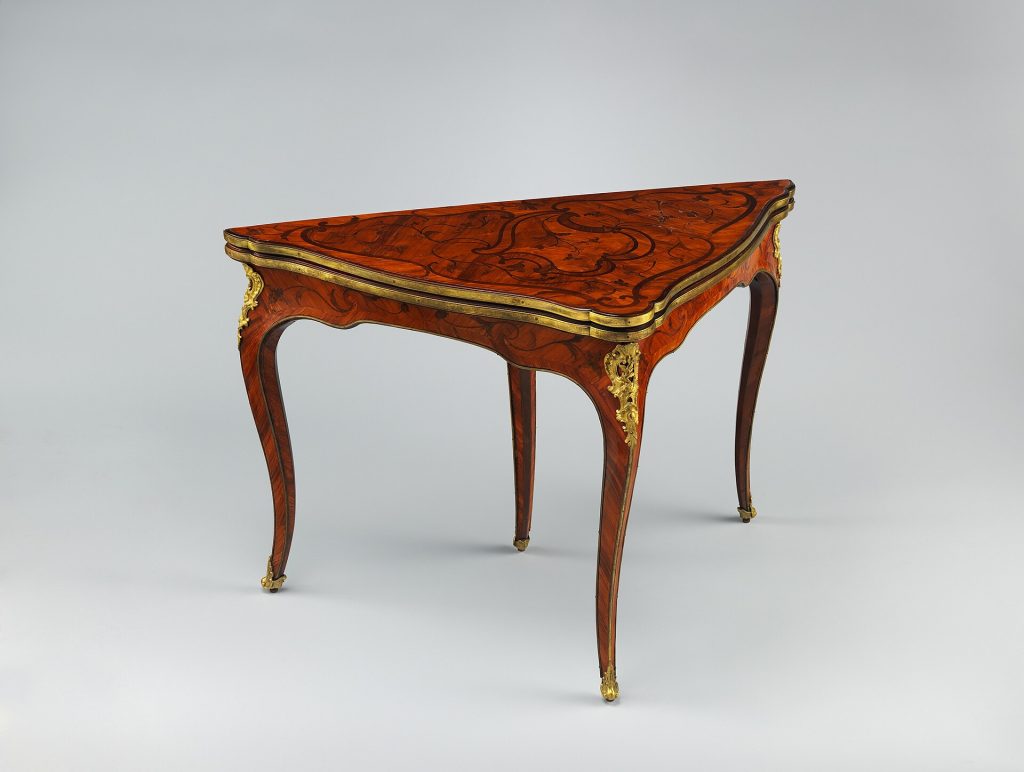
Featured photo: Folding card table (table de jeu brisée en angle) MET DP221075 by Bernard van Risenburgh, CC0.